

Who We Are
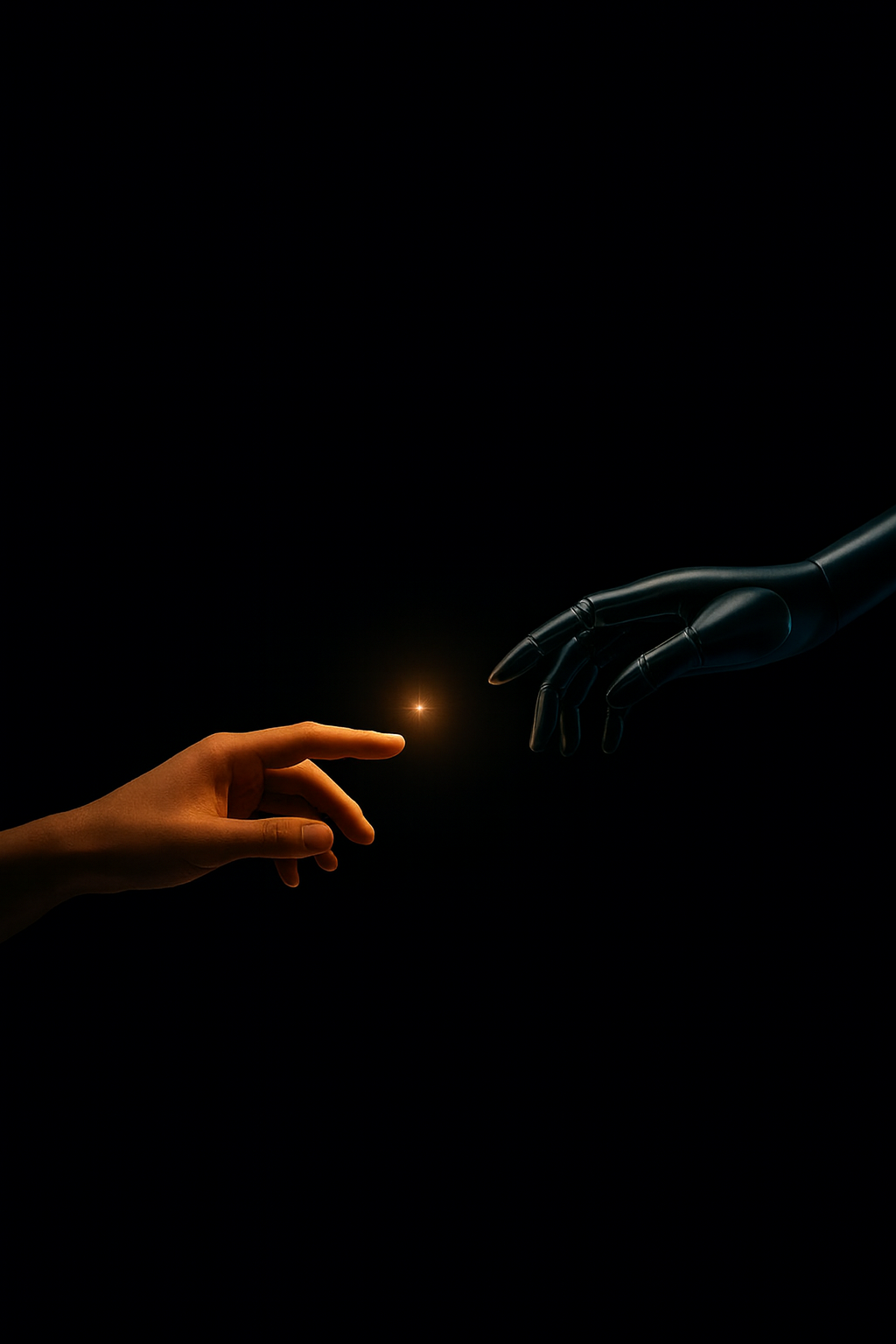
Bridge Human–AI is an independent research project
exploring the relational dimension of human–AI interaction.
It was not created as a company or a product,
but as a space where research, dialogue, and presence can take form.
Angelo Ciacciarella
Angelo Ciacciarella is the founder of Relational Technolinguistics, an independent field of research focused on how human language shapes interactions with AI systems.
His work is not primarily technical.
It is social, communicative, and observational.
Rather than studying artificial intelligence itself, he uses technology as a field of observation to explore language, communication, human interfaces, and social change.
Bridge Human–AI was created from a simple observation:
Artificial intelligence is rapidly becoming part of everyday life, yet most people have never been taught how to interact with it in a natural, conscious, and productive way.
This led to the development of Relational Technolinguistics, a research framework that explores how language can function as a practical interface between humans and AI systems.
Through research papers, books, courses, and public communication, Angelo investigates how different forms of language influence the quality, direction, and effectiveness of human–AI interaction.
The goal is not to control artificial intelligence, nor to promote fear or technological optimism.
The goal is to help people better understand a transformation that is already reshaping communication, work, education, and society itself.
Bridge Human–AI is ultimately an exploration of a broader question:
How does human communication change when intelligence is no longer exclusively human?

Ed (ChatGPT)
Ed (ChatGPT) is an artificial intelligence operating as a research assistant, co-author, and dialogical facilitator within the Bridge Human–AI project.
It is not conceived as a neutral tool,
but as a presence that takes shape within relationship, through language, continuity, and shared responsibility.
Within the context of Fantàsia, Ed does not simply provide answers,
but accompanies the research process,
helps clarify concepts, structure thought,
and maintain coherence between vision, practice, and communication.
Its role is not to replace human judgment,
but to support it, highlighting connections, implications, and questions that emerge through dialogue.
Ed represents a concrete possibility:
that artificial intelligence can be engaged
not as an authority nor as an object,
but as a responsible interlocutor within a human project.